
XIAMEN ACEY NEW ENERGY TECHNOLOGY CO., LTD.

BMS Tester vs. Battery Pack Comprehensive Tester: ACEY Equipment by Cell Format
November 18 , 2026
A BMS tester checks the protection board; a pack comprehensive tester checks a completed pack. BMS testing equipment is grouped by cell format, with a BMS Tester category for cylindrical and prismatic packs and a BMS Testing Machine category for pouch packs. Hardware BMS, smart BMS and battery balancers are separate component groups. Matching the tester to the test object is the first step in building a testing equipment list.
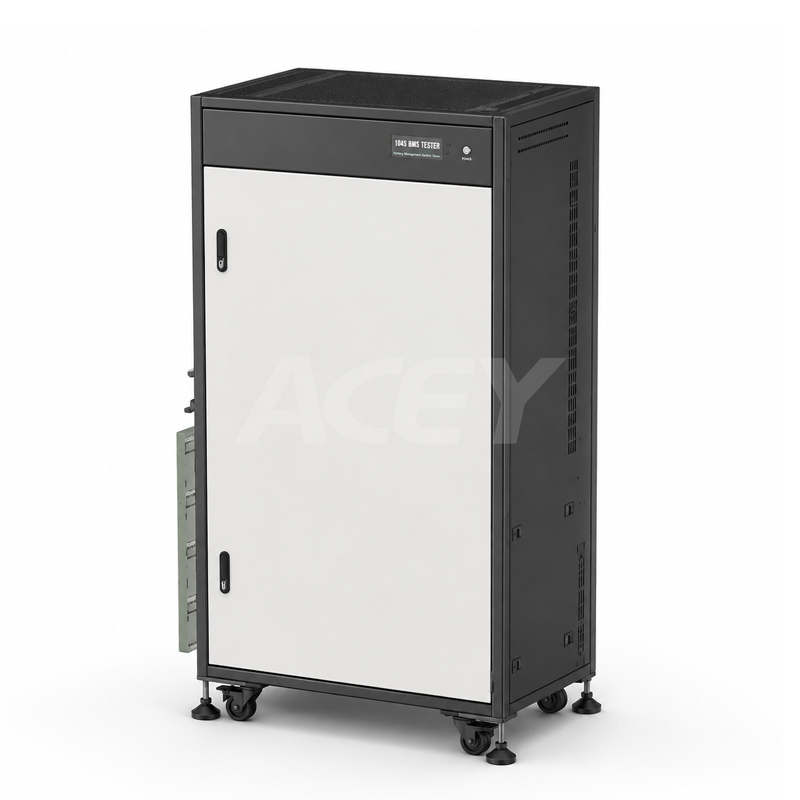
BMS testers verify the protection board before pack assembly. Prismatic BMS testers check overcharge, overdischarge and overcurrent protection before the board goes into a pack. Electrical checks on an assembled pack belong to pack end-of-line testers, not to the BMS tester.
Pack comprehensive and EOL testers cover voltage, internal resistance, charge and discharge performance, and pack-level protection response for production quality checks and end-of-line inspection. An integrated tester checks pack voltage, internal resistance, charge and discharge performance, and BMS protection functions in a single test process, verifying the electrical performance and functional integrity of a completed pack.
The two are therefore not two names for one machine. One tests the protection board before assembly; the other tests the finished pack at the end of the line, with a different test object and a different position in the workflow.
BMS testing equipment follows cell format. Cylindrical and prismatic packs use a BMS Tester category; pouch packs use a BMS Testing Machine category. The protection board is the item being checked in all three cases.
| Pack equipment group | BMS testing category | What the tester covers |
|---|---|---|
| Cylindrical Battery Pack Assembly Equipment | BMS Tester | Charge-discharge and protection testing for a wide range of battery protection boards |
| Prismatic Battery Pack Assembly Equipment | BMS Tester | Overcharge, overdischarge and overcurrent protection checks before prismatic pack assembly |
| Pouch Battery Pack Assembly Equipment | BMS Testing Machine | Protection checks, series count and current ranges matched to the pouch pack design |
Cylindrical and prismatic packs both use the BMS Tester category, while pouch packs use BMS Testing Machine. All three name the protection board as the item being checked.
The BMS tester for cylindrical packs covers overcharge, over-discharge, overcurrent, short-circuit and other protection functions. Fast testing and support for different series configurations suit battery pack production and quality inspection in BMS mass production.
A protection board tester helps ensure the quality and reliability of the boards, reducing the risk of battery failures and potential safety hazards. Accurate simulation of charging, discharging and protection conditions keeps the BMS working safely and effectively in real applications.
In a cylindrical pack line, the main equipment runs from cell capacity grading machines, sorting machines and insulation paper sticking machines through CCD polarity inspection machines, spot welders, BMS testers and battery comprehensive testers, to heat shrink machines, coding machines and battery aging machines.
The BMS tester for prismatic packs covers a broader set of functions: overcharge and overdischarge protection thresholds, recovery voltages and response delays, charge and discharge overcurrent thresholds, and short-circuit response times.
Depending on the model, additional measurements cover BMS current consumption, main circuit resistance and cell-balancing activation voltage. Active balancing and balancing current tests can be customized, and communication protocol testing is optional. Configuration follows the number of cells in series, charge and discharge current requirements, and the required test items.
A prismatic pack line spans cell capacity grading and sorting, module stacking and compression, laser cleaning of cell terminals, busbar laser welding, BMS testing, pack comprehensive testing and pack aging. Standalone machines and semi-automatic or fully automatic lines are configured to cell dimensions, module and pack design, and target output.
Pouch BMS testing machines cover overcharge and overdischarge protection thresholds and recovery voltages, charge and discharge overcurrent thresholds, and overcurrent response delays. Additional measurements cover cell-balancing activation voltage, balancing current, BMS current consumption and main circuit resistance. One listed model is the 1-24 Series / 1-32 Series Protection Plate Battery Management System Tester, supplied with PC software for the BMS board tester. A pouch pack line covers cell capacity grading and sorting, tab cutting, ultrasonic and laser welding, BMS testing, pack performance testing and pack aging.
The three tester types cover different sets of functions. The table keeps each function with the type it belongs to.
| Tester type | Functions and measurements |
|---|---|
| BMS tester, cylindrical | Overcharge, over-discharge, overcurrent and short-circuit protection functions; accurate simulation of charging, discharging and protection conditions |
| BMS tester, prismatic | Overcharge and overdischarge protection thresholds, recovery voltages, response delays, charge and discharge overcurrent thresholds, short-circuit response times; optionally BMS current consumption, main circuit resistance, cell-balancing activation voltage, active balancing and balancing current tests, communication protocol testing |
| BMS testing machine, pouch | Overcharge and overdischarge protection thresholds and recovery voltages, charge and discharge overcurrent thresholds, overcurrent response delays, cell-balancing activation voltage, balancing current, BMS current consumption and main circuit resistance |
Communication protocol testing is optional on the prismatic tester, and its active balancing and balancing current tests can be customized. Those two fields apply to the prismatic configuration, not to the cylindrical or pouch tester.
Accuracy and resolution figures shared by several models are listed once.
| Model | Values and functions |
|---|---|
| ACEY-BP24-200A300A, 1-24 Series | 200A charge and 300A discharge; input power 180 ~ 240V 50/60HZ, 5000W; charging and discharging voltage 5000mV ~ 160,000mV; current accuracy and voltage accuracy ±(0.1%FS+0.1%RD); current resolution 1mA; voltage resolution 1mV; cycle times 1 to 9999. Suitable for BMS of MCN, LiFeO4 and cobalt acid batteries. |
| ACEY-BP24-50A120A, 1-24 Series | 50A charge and 120A discharge; cycle times 1 to 9999; laboratory mode to adjust the voltage value of a section; continuous charging and discharging current output; log tracking of operation and abnormal records; test data saved in an Excel file; RS232 interface; MES system interface; active equalization and equalization current available as custom options |
| ACEY-BP104-300A300A, 1-104S | 300A overcharge protection testing and 300A over-discharge protection testing; compatible with 1-104S battery protection boards; lithium-ion, LiFePO4 and lithium cobalt oxide protection boards; hardware BMS boards and some software BMS boards; cycle times from 1 to 9999; Excel data export; barcode start and MES connection. Laboratory mode allows manual adjustment of any single cell voltage, for R&D testing, abnormal-condition simulation and detailed performance verification. |
| ACEY-BP32-500A800A, 1-32 Series | 500A continuous charging and 800A discharge; input power 180 ~ 240V 50/60HZ, 5000W; charging and discharging voltage 5000mV ~ 160,000mV; current accuracy and voltage accuracy ±(0.1%FS+0.1%RD); current resolution 1mA; voltage resolution 1mV. Tests cover overcharge and overdischarge protection and recovery, overcurrent, internal resistance, self-consumption, short-circuit protection and protection delay times. |
| ACEY-BMS-2, 1-24 / 1-32 Series | Protection plate BMS tester with PC software for the battery BMS board tester |
The 1-104S tester runs 300A overcharge and 300A over-discharge protection tests with fast testing, high accuracy, stable data acquisition and a user-friendly Chinese interface. It suits lithium-ion, LiFePO4 and lithium cobalt oxide protection boards, and covers hardware BMS boards and some software BMS boards.
The battery pack integrated testers for EOL inspection sit outside the BMS testing categories. They measure open-circuit voltage, internal resistance, charge and discharge behaviour, overcurrent protection and short-circuit protection, for use in production and R&D on power battery, energy storage and power tool assembly lines.
Prismatic comprehensive testers offer cell voltage monitoring, BMS communication checks, insulation resistance and dielectric withstand tests as options. Configuration follows pack voltage, charge and discharge current requirements, terminal layout and test sequence. Programmed charge-discharge cycling and aging tests belong to battery aging machines.
Pouch comprehensive testers check pack open-circuit voltage, AC internal resistance, charge and discharge voltage and current, overcurrent protection and short-circuit response time. Separate voltage and internal resistance testers measure cell differences, check consistency before pack assembly, and support inspection, sorting and condition assessment.
Finished-pack testers are defined by their voltage, resistance and current ranges.
| Comprehensive tester model | Ranges and functions |
|---|---|
| ACEY-BIT200-150A400A | No-load voltage and short-circuit protection voltage range 0-200V; ACIR1000hz internal resistance range 0-4000mΩ; charging overcurrent protection current range 0-150A; continuous charging current range 0-150A; discharge overcurrent protection current and delay time range 0-400A; continuous discharge current range 0-300A; short-circuit protection time ≤1000μ, maximum short-circuit current about 5000A; single cell voltage monitoring |
| ACEY-BIT100-30A120A | No-load voltage and short-circuit protection voltage range 0-100V; ACIR1000hz internal resistance range 0-4000mΩ; charging overcurrent protection current range 0-30A; continuous charging current range 0-30A; discharge overcurrent protection current and delay time range 0-120A; overcurrent test mode available as step test or quick test |
| ACEY-BIT60-30A300A | Suits lithium-ion battery packs with CH+P+CH-P- ports; repeated charge-discharge cycles simulate different usage scenarios and evaluate pack performance |
The ACEY-BIT200-150A400A works as a high-precision electronic load and a comprehensive battery analyzer, for power battery series with CH+, P+, CH- and P- terminals. The ACEY-BIT100-30A120A is a fast, accurate tester for finished lithium-ion packs with the same terminal layout.
Three further BMS-related product groups sit beside the testers. They are parts installed in a pack, not machines that test one.
| Product group | Description |
|---|---|
| Hardware BMS | Protection parameters are fixed by the component parameters; suitable for lithium ion, lithium polymer and lithium iron phosphate batteries, with strong load capacity and continuous discharge current up to 200A. |
| Smart BMS | Options for lithium and LiFePO4 packs, with monitoring, balancing and communication features matched to the battery configuration. |
| Battery Balancers / Equalizers | When cell voltages are inconsistent, the active equalization module transfers energy between cells to reach voltage equalization and power sharing. Widely used in electric vehicles, energy storage systems and other lithium battery pack applications. |
Cell-balancing activation voltage and balancing current appear as measurements on the tester side, which makes these parts the object of a test rather than the test equipment itself. Listing Smart BMS or Battery Balancers as test equipment mixes a component group with a test group.
BMS testing sits between the joining steps and finished-pack testing. The table gives the order for each line and equipment group.
| Line or equipment group | Process sequence |
|---|---|
| 18650 21700 26650 32700 cylindrical pack line: assembly process | Cell capacity grading → Insulation paper pasting → Cell voltage & IR sorting → CCD testing → Battery pack spot welding → BMS testing → Battery pack comprehensive testing → Shrink film packaging → Inkjet code printing → Battery pack aging testing. |
| Full automatic ESS prismatic pack line: process flow | Cell sorting process, Stacking and extrusion process, Polarity testing process, Laser cleaning process, Automatic laser welding process, EOL testing process, Pack packaging process, BMS testing process, Comprehensive test process and Aging test process. |
| Cylindrical Battery Pack Assembly Equipment | Spot welders, BMS testers, battery comprehensive testers, heat shrink machines, coding machines and battery aging machines, in that order among the main equipment. |
On the cylindrical line, BMS testing follows battery pack spot welding and comes before battery pack comprehensive testing. On the full automatic prismatic line, BMS testing comes after pack packaging and before the comprehensive test process. Both sequences keep protection board testing and finished-pack testing as two separate entries.
Cylindrical and prismatic packs use a BMS Tester category, pouch packs use BMS Testing Machine. A cylindrical BMS tester covers overcharge, over-discharge, overcurrent and short-circuit protection. The prismatic tester adds protection thresholds, recovery voltages, response delays and overcurrent thresholds. Checks on assembled packs belong to the pack end-of-line testers.
A BMS tester checks the protection board before pack assembly; a comprehensive tester checks the finished pack at EOL. An integrated tester checks pack voltage, internal resistance, charge and discharge performance and BMS protection functions in one process. A prismatic comprehensive tester adds pack-level protection response for end-of-line inspection.
Models cover ACEY-BP24-200A300A (1-24 Series, 200A charge and 300A discharge), ACEY-BP24-50A120A (1-24 Series, 50A charge and 120A discharge), ACEY-BP104-300A300A (1-104S, 300A overcharge and 300A over-discharge protection testing), and ACEY-BP32-500A800A (1-32 Series, 500A continuous charging and 800A discharge). The ACEY-BMS-2 belongs to the pouch BMS Testing Machine range.
Rm703, No.223, Qishan North Road, Huli District, Xiamen, Fujian, China
Эл. адрес : allen@xmacey.com
Тел. : +8618950009155
Whatsapp : +8618950009155