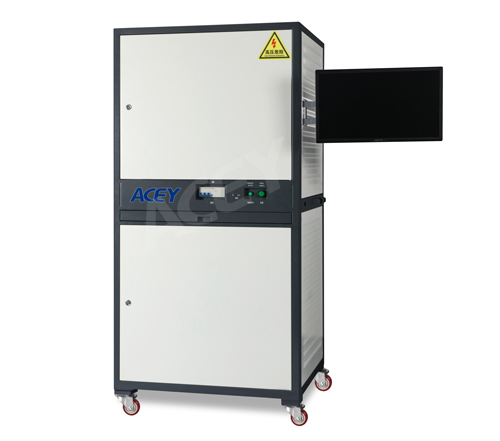
XIAMEN ACEY NEW ENERGY TECHNOLOGY CO., LTD.

Категории
Новый блог
What Is Battery Pack EOL Testing? EOL Testing vs. Aging Testing
September 18 , 2026What Is Battery Pack EOL Testing? EOL Testing vs. Aging Testing
Key Takeaways
What Does EOL Mean in Battery Pack Manufacturing?
EOL stands for End of Line.
In battery pack manufacturing, it refers to the inspection carried out after the main assembly work has been completed.
A simplified production sequence look like:
Pack Assembly → Welding → BMS & Wiring → Enclosure Assembly → EOL Testing → Final Inspection
At this stage, the purpose is no longer to assemble the battery. The purpose is to find problems that may have occurred during assembly before the pack is approved.
An EOL test can detect issues related to electrical connections, insulation, communication, sensor signals, or battery data.
For production use, several test functions are often combined into one test sequence rather than being checked separately by different operators.
What Is Tested During Battery Pack EOL Testing?
The EOL test program is built around the electrical and functional requirements of the battery pack.
Test items include the following:
| Test Item | What It Checks |
| Open-Circuit Voltage | Whether total pack voltage is within the set range |
| AC Internal Resistance | Electrical resistance of the battery pack |
| Insulation Resistance | Isolation between the battery circuit and enclosure |
| AC / DC Withstand Voltage | Insulation performance under a defined test voltage |
| Communication | Whether the pack communicates correctly with the test system |
| Cell Voltage | Individual cell or cell-group voltage readings |
| Temperature Data | Temperature sensor readings inside the pack |
| Voltage Comparison | Comparison between measured voltage and pack-reported voltage |
| Current Comparison | Comparison between test current and pack-reported current |
| SOC | State-of-charge information |
| SOH | State-of-health information |
| Serial Number | Pack identification and traceability |
| Pass / Fail | Whether test results meet the preset limits |
These functions allow the EOL station to check several parts of the finished battery pack in one test process.
Why Is Pack Voltage Checked During EOL Testing?
Pack voltage is one of the first basic checks after assembly.
If the measured voltage is outside the expected range, the cause may be related to the electrical connection, cell groups, wiring, or another assembly issue.
Voltage can also be checked at more than one point during the EOL process.
For example, a pack may first be measured in its initial state and then measured again after other test items have been completed. The second measurement helps confirm that the pack remains electrically normal after the test sequence.
This is more useful than treating voltage as a single isolated reading.
Why Are Insulation Resistance and Withstand Voltage Tested?
Voltage measurement tells you the electrical condition of the battery terminals. It does not tell you whether the high-potential circuit is properly isolated from the enclosure.
That is the purpose of insulation testing.
Insulation Resistance
The insulation resistance test checks the resistance between the battery circuit and the enclosure.
Measurement points include:
Pack Positive Terminal → Enclosure
and
Pack Negative Terminal → Enclosure
A low resistance value can indicate an insulation problem that requires further inspection.
AC/DC Withstand Voltage
A withstand-voltage test applies a defined electrical stress between the battery circuit and the enclosure.
The tester monitors leakage current during the test. If leakage exceeds the set limit, the pack does not pass that test item.
Insulation resistance and withstand-voltage testing therefore answer a different question from normal voltage measurement: is the electrical system sufficiently isolated from the enclosure?
EOL Testing vs. Aging Testing
EOL testing and aging testing may both involve voltage, current, temperature, and battery data, but they are used for different jobs.
| Test Item | EOL Testing (Line-End Final Inspection) | Aging Testing (Formation / Aging Station) |
| Main Purpose | Assembly quality, HV safety, BMS system verification, SOC calibration, functional check, and release for shipment | Cell activation, verify pack capacity & cell consistency, screen out early-failure packs |
| Main Output | Pass / Fail result + SOC calibration & sampling accuracy data | Capacity, OCV, cell voltage difference, and performance data |
| Voltage Measurement | Yes — mandatory: total pack voltage + all cell voltages | Yes — mandatory |
| Insulation Resistance | Mandatory | Generally not performed (not a core item) |
| Withstand Voltage (HIPOT) | Mandatory | Generally not performed |
| Ground / Continuity Check | Mandatory | Not a core item |
| HVIL / Pre-charge / Contactor Test | Mandatory | Not a core item |
| Communication Check (BMS-CAN/RS485, DTC) | Mandatory | Required — used to monitor aging process messages |
| Charge / Discharge | Standard process: short pulse charge/discharge, SOC calibration — no full charge/discharge cycle | Core function: one full charge/discharge cycle (mainstream); multiple cycles are rare |
| Capacity Test | Not a full capacity cycle; only SOC calibration & capacity spot check | Core function: measured actual pack capacity |
| Charge/Discharge Curves | Not the main output (only pulse segments collected) | Key data: full charge/discharge curves saved for consistency analysis |
| Cycling | Not performed | Line aging ≠ lab cycle-life test — usually only one charge/discharge cycle; multiple cycles belong to reliability lab, not production line |
| Data Recording | Full quality data archived to MES, bound to serial number (SN) | Capacity, voltage difference, and aging process performance data archived |
The distinction becomes clearer when looking at the test sequence.
EOL testing equipment works through a series of inspection items and checks whether each one meets the required limit.
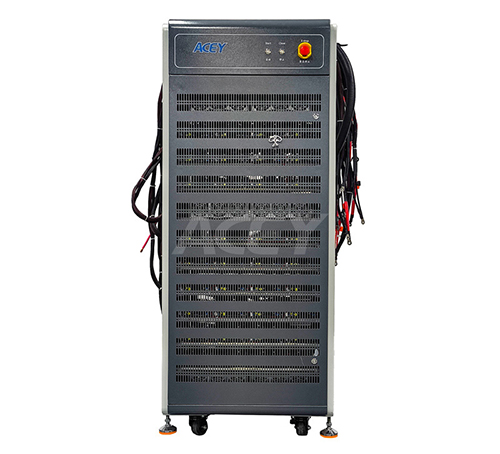
Battery aging test equipment works through programmed operating steps such as:
Charge → Rest → Discharge → Rest → Cycle
Its job is to record what happens to the battery throughout that process.
What Happens During Battery Aging Testing?
Battery aging testing is based on programmable charge and discharge operation.
The test program include:
Why Are EOL Testing and Aging Testing Both Used?
They solve different quality-control problems.
EOL testing answers:
FAQ
*What is battery pack EOL testing?
Battery pack EOL testing is the final electrical and functional inspection performed after battery pack assembly. It checks whether the finished pack meets the required test limits before it passes the production line.
*What does an EOL test check?
Typical items include pack voltage, internal resistance, insulation resistance, withstand voltage, communication, cell voltage, temperature data, SOC/SOH information, and production traceability.
*What is the difference between EOL testing and aging testing?
EOL testing is mainly used for final production inspection and Pass/Fail judgment. Aging testing evaluates battery behavior during programmed charge, discharge, rest, and cycling processes.
*Is battery aging the same as cycle testing?
Aging equipment can perform repeated cycle testing, but it can also be used for capacity, charge/discharge characteristic, and temperature-related tests. The test program is set according to the required evaluation.
*Does EOL testing include capacity testing?
A full capacity test is normally carried out through a controlled charge/discharge process and is more closely associated with aging or charge/discharge testing. EOL testing can include shorter functional checks but does not use a full capacity cycle as its main inspection method.
*What is the difference between insulation resistance and withstand-voltage testing?
Insulation resistance testing measures the resistance between the battery circuit and the enclosure. Withstand-voltage testing applies a defined electrical stress and monitors whether the insulation remains within the specified leakage limit.
703, 7F, Zhonghengji Building, No.223, Qishan North Road, Huli District, Xiamen, Fujian, China
Эл. адрес : allen@xmacey.com
Тел. : +8618950009155
Whatsapp : +8618950009155