
XIAMEN ACEY NEW ENERGY TECHNOLOGY CO., LTD.

Категории
Новый блог
Как собрать цилиндрическую аккумуляторную батарею: руководство по процессу и оборудованию
August 28 , 2026Как собрать цилиндрический аккумуляторный блок: руководство по процессу и оборудованию.
Цилиндрические аккумуляторные батареи, используемые в электроинструментах, электровелосипедах, дронах, портативных электростанциях и системах хранения энергии, могут значительно различаться по напряжению, емкости и конструкции, но большинство производственных линий используют схожую последовательность сборки.
Основные этапы включают сортировку емкости ячеек, нанесение изоляционной бумаги, сортировку по напряжению холостого хода и внутреннему сопротивлению, компоновку ячеек, проверку полярности, точечную сварку, тестирование BMS.иустановкаЗавершено тестирование упаковки, ее комплектация, кодирование и испытания на старение при заряде-разряде.
Эти процессы могут быть организованы в виде автономных рабочих мест, полуавтоматической линии или полностью автоматизированной производственной линии.
Процесс сборки цилиндрического аккумуляторного блока
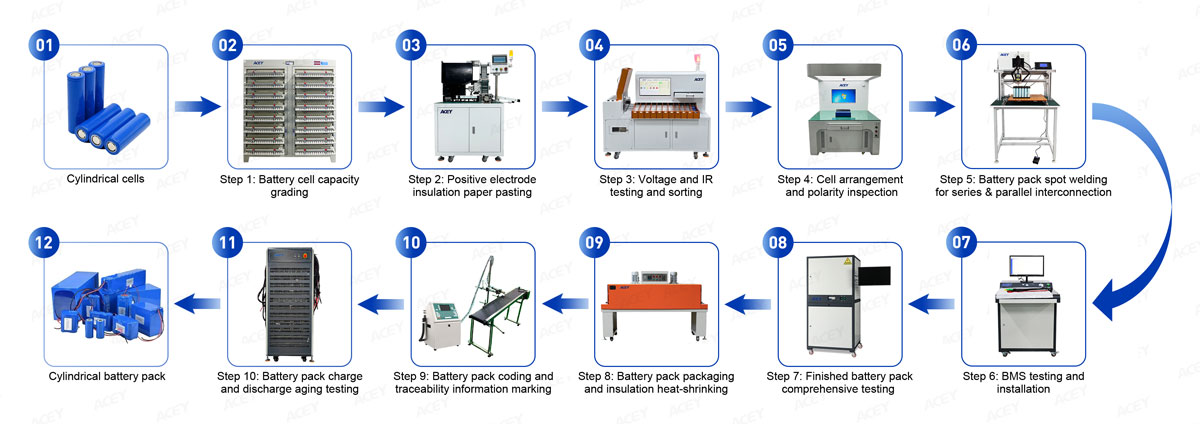
Классификация емкости элементов → Нанесение изоляционной бумаги → Сортировка по OCV и ACIR → Расположение элементов → Проверка полярности → Точечная сварка → Тестирование и установка BMS → Тестирование аккумуляторных батарей → Упаковка и маркировка → Испытание на старение при зарядке/разрядке
Первые несколько этапов сосредоточены на обеспечении однородности ячеек и правильного расположения. Сварка и сборка BMS обеспечивают электрическое соединение блока, а тестирование и старение готового блока используются для проверки собранной батареи перед отгрузкой.
Основные компоненты цилиндрического аккумуляторного блока
Цилиндрический аккумуляторный блок состоит, главным образом, из:
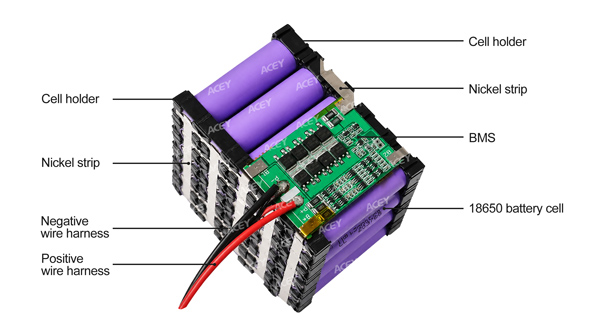
Последовательное соединение определяет напряжение батареи, а параллельное соединение увеличивает емкость и токовую нагрузку.
Типичные размеры и области применения цилиндрических ячеек
Поддерживаемые форматы ячеек
14500 · 18650 · 21700 · 26650 · 32650 · 32700 · 32140 · 33140
Не все станки используют одинаковые инструменты. При изменении диаметра, высоты или структуры ячеек может потребоваться замена зажимов, держателей ячеек и механизмов подачи.
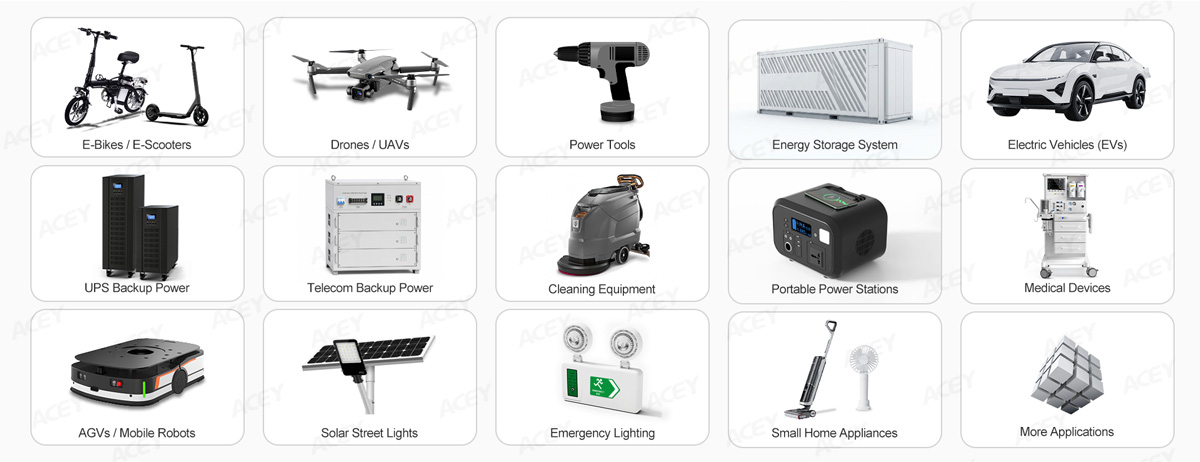
Типичные области применения
Какое оборудование используется для сборки цилиндрического аккумуляторного блока?
Полный комплект оборудования для производства может включать следующее:
| Процесс | Цель | Оборудование |
| Классификация мощности | Измерьте и сгруппируйте ячейки по вместимости. | Машина для сортировки аккумуляторных элементов |
| Изоляция | Наклейте изоляционную бумагу на положительный полюс | Машина для приклеивания изоляционной бумаги |
| Сортировка OCV и ACIR | Сгруппируйте элементы по напряжению и сопротивлению. | Машина для сортировки батарей |
| Проверка полярности | Проверять положительный и отрицательный полюса блока | Устройство для проверки полярности ПЗС-матриц. |
| Электрическое соединение | Приварите соединительные полосы к ячейкам. | Аппарат для точечной сварки аккумуляторных батарей |
| Проверка системы управления зданием (BMS) | Функции платы защиты от тестирования | Тестер BMS |
| Завершено тестирование упаковки. | Проверьте работоспособность собранного комплекта. | Комплексный тестер аккумуляторов |
| Упаковка | Наклейте термоусадочную пленку | Термоусадочная машина |
| Идентификация | Распечатать информацию о партии и продукте. | Кодировочная машина |
| Старение | Выполняйте циклы зарядки-разрядки. | Тестер старения аккумуляторных батарей |
При изготовлении прототипов или мелкосерийном производстве ряд операций может оставаться ручным. Массовые производственные линии автоматизируют процессы, которые в наибольшей степени влияют на стабильность и производительность, особенно сортировку, проверку полярности, сварку и тестирование.
Шаг 1 — Оценка емкости ячеек
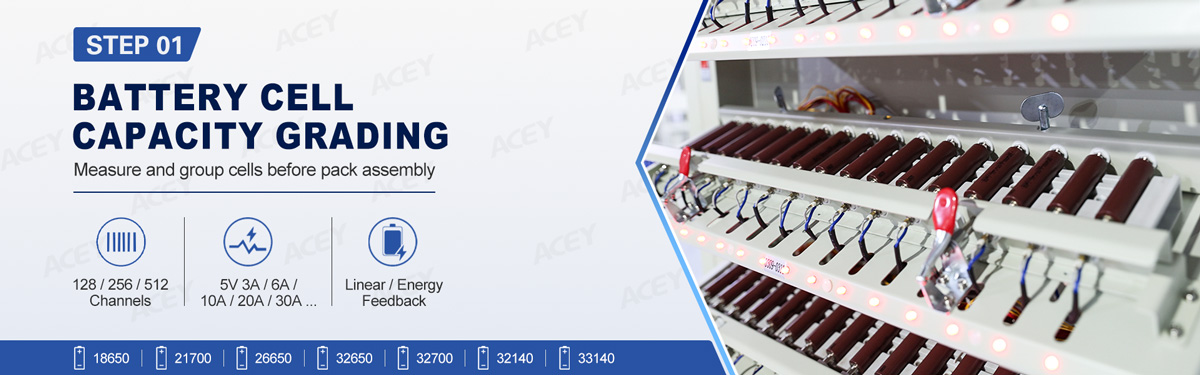
Перед сборкой элементы заряжаются и разряжаются для измерения полезной емкости и основных характеристик.
Цель состоит в том, чтобы предотвратить объединение в один аккумуляторный блок элементов с существенно различающейся емкостью, возникающей в результате истощения или потери заряда во время длительного хранения или транспортировки. Более слабые элементы ограничивают полезную производительность всей последовательной или параллельной сборки.
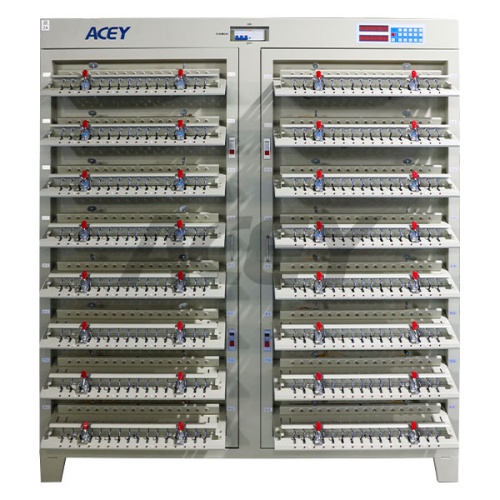
А литиумион машина для сортировки клеток Выполняет запрограммированные циклы заряда-разряда по нескольким каналам и записывает данные для каждой ячейки.
Системы выравнивания грунта ACEY могут быть сконфигурированы для распространенных цилиндрических форматов, таких как:
18650 · 21700 · 26650 · 32650 · 32700 · 32140 · 33140
Доступные конфигурации включают:
Для крупномасштабной обработки ячеек многоканальная сортировка позволяет тестировать сотни ячеек одновременно, прежде чем они поступят на этап сборки аккумуляторных блоков.
Рекомендуемое оборудование: Машина для сортировки аккумуляторных элементов.
Шаг 2 — Нанесение изоляционной бумаги
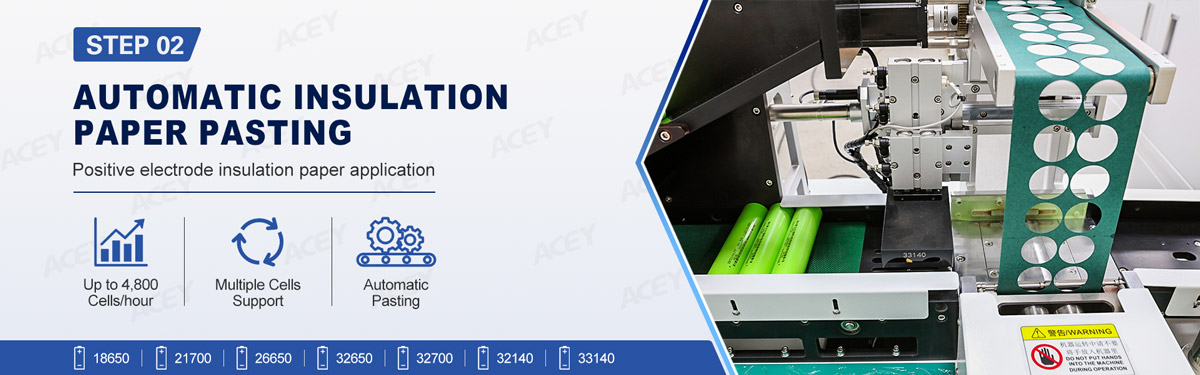
После определения необходимой мощности вокруг положительного полюса наносится изоляционная бумага.
Эта дополнительная изоляция помогает отделить область положительного полюса от металлического корпуса элемента (анода) во время сборки.
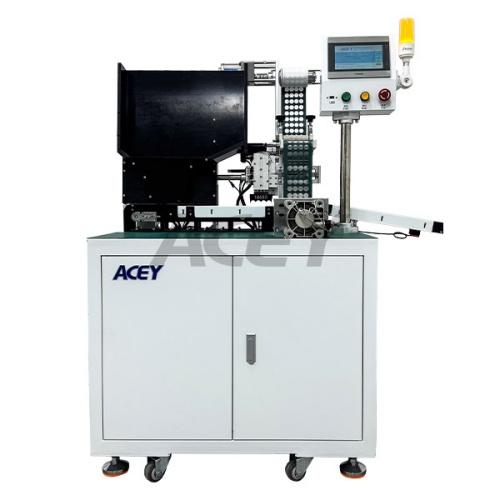
Анавтоматическая машина для приклеивания изоляционной бумагиМашины ACEY обрезают и наносят бумагу с обеспечением равномерного позиционирования. Они могут быть оснащены сменной оснасткой для различных цилиндрических ячеек.
В зависимости от конфигурации ячейки и оборудования, скорость производства может достигать 4800 ячеек в час.
К распространённым форматам относятся:
18650 · 21700 · 26650 · 32650 · 32700
Larger cylindrical cells such as 32140 and 33140 require suitable tooling and machine configuration.
Recommended Equipment: Battery Insulation Paper Sticking Machine
Step 3 — OCV and Internal Resistance Sorting
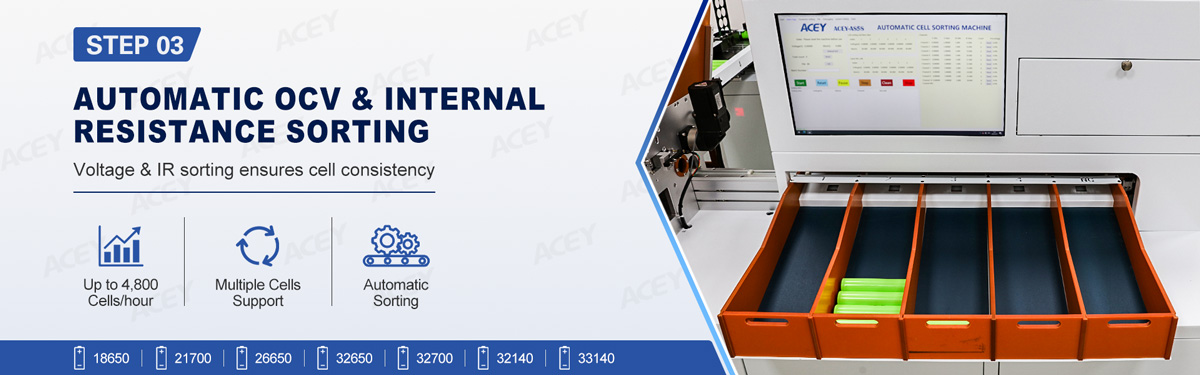
Capacity grading alone is not enough for final cell matching.
Before assembly, it is also necessary to measure theopen-circuit voltageandAC internal resistanceof the battery cells to ensure the consistency of the battery pack.
The measured values are compared with preset ranges, and the cells are automatically separated into different groups.
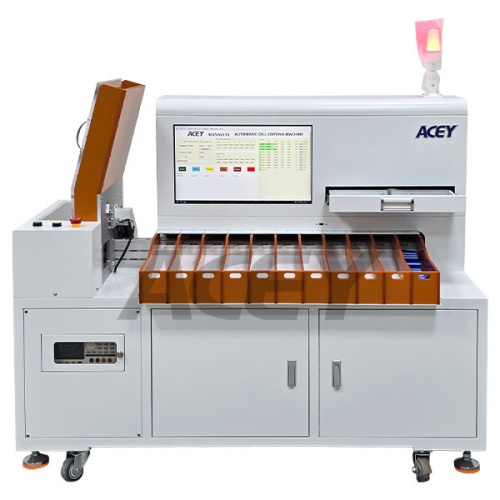
ACEY cylindrical battery sorting machines are available with standard 5-, 6-, 10-, or 11-channel configurations, with customized options also available. They can be integrated with branded testers such as the HIOKI BT3561 or other compatible instruments to measure open-circuit voltage (OCV) and AC internal resistance.
Barcode scanning can also be added when the production process requires cell-level traceability.
Cells with large differences in voltage or resistance may behave differently under charge and discharge. Sorting helps the manufacturer build packs from cells with closer electrical characteristics.
For production lines that combine insulation paper application and sorting, these processes can also be integrated to reduce repeated cell handling.
Recommended Equipment: Cylindrical Battery Sorting Machine
Step 4 — Cell Arrangement and Polarity Inspection
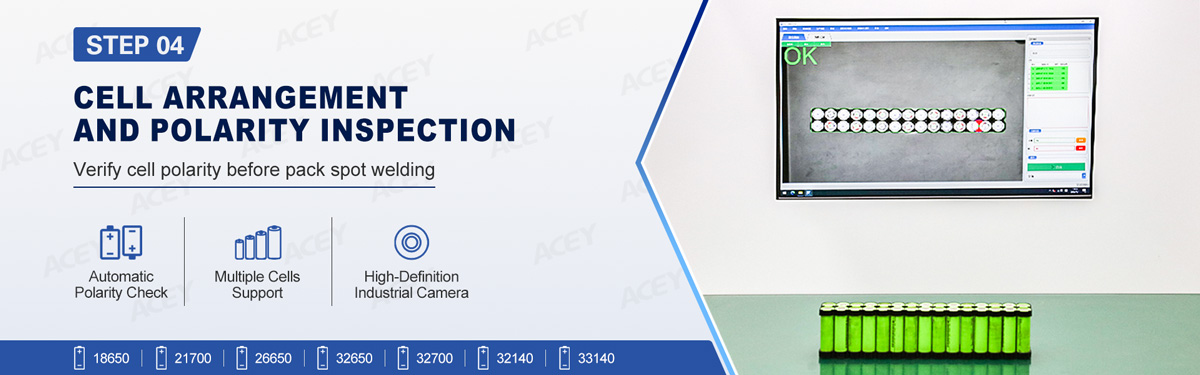
Sorted cells are placed into the required series-parallel arrangement using cell holders or dedicated fixtures.
Before welding, the positive and negative orientation of every cell should be checked.
For small production runs, this may be done manually. On semi-automatic and automatic lines, a CCD polarity inspection system is more reliable because it checks the complete cell group against the preset pattern.
ACEY CCD inspection systems can be configured for cylindrical cells including:
18650 · 21700 · 26650 · 32650 · 32700 · 32140 · 33140
Any reversed or incorrectly positioned cell can be identified before the pack enters the welding station.
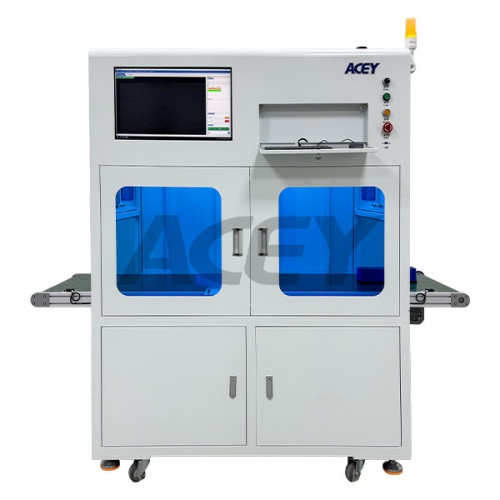
Recommended Equipment: CCD Tester
Step 5 — Battery Pack Spot Welding
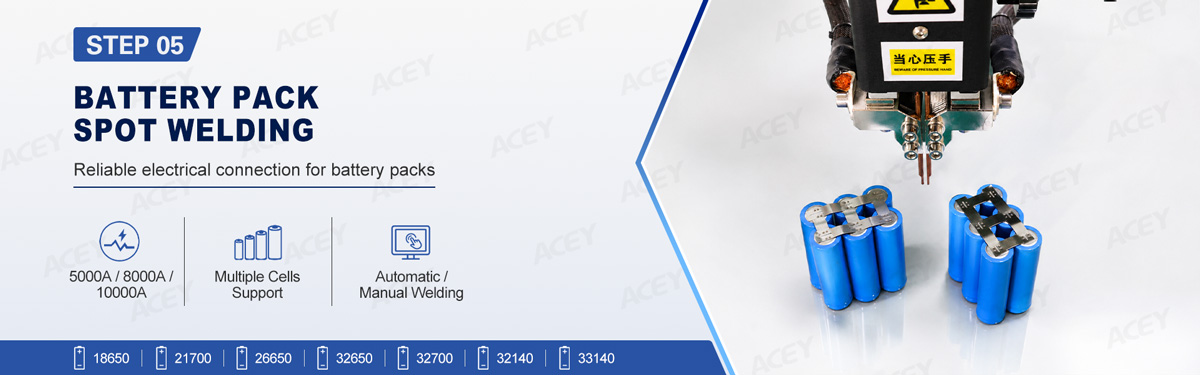
Spot welding is one of the most important operations in cylindrical battery pack assembly.
The cells are connected in series and parallel by welding nickel or nickel-plated connecting strips to the cell terminals.
The welding result is affected by more than welding current. The main process variables include:
ACEY provides 5000A, 8000A and 10000A DC inverter or transistor welding power supply configurations for cylindrical battery pack assembly.
Machine options include:
Automatic models can store welding programs for different battery pack designs and move between preset welding positions.
For production use, welding parameters should be validated with the actual cell and connecting strip. A parameter that works well on one battery pack should not automatically be copied to another design.
The inspection criteria may include weld appearance, connection strength and electrical resistance according to the manufacturer’s own process standard.
Recommended Equipment: Battery Pack Spot Welding Machine
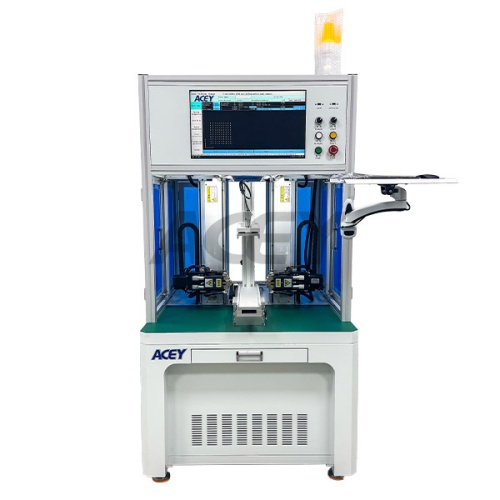
Step 6 — BMS Testing and Installation
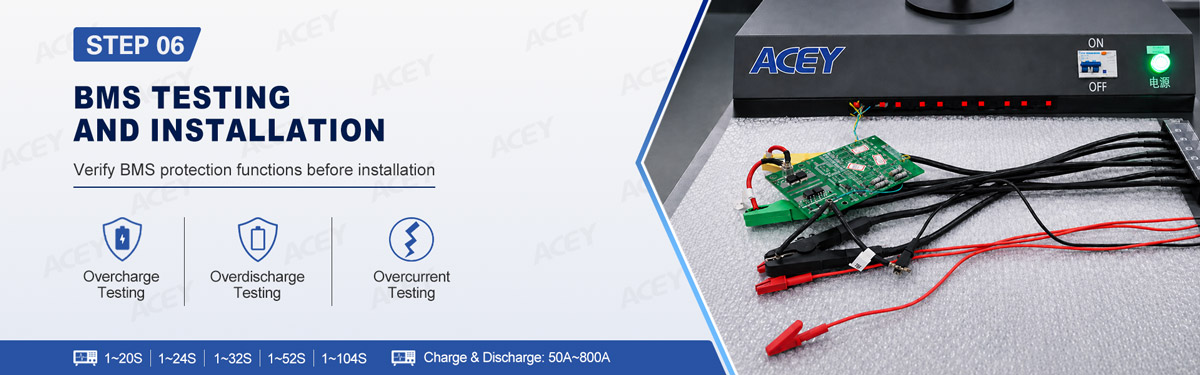
After the cell groups are electrically connected, the battery management system is installed according to the pack design.
Before installation or final integration, the BMS can be tested to verify its protection functions.
A BMS tester mainly check functions such as:
The required test range is determined by the BMS series count, voltage and current rating.
After BMS verification, assembly work includes:
This part of the process varies significantly from one battery pack to another. BMS specifications and electrical drawings are therefore important when configuring the assembly workstation or production line.
Recommended Equipment: BMS Tester
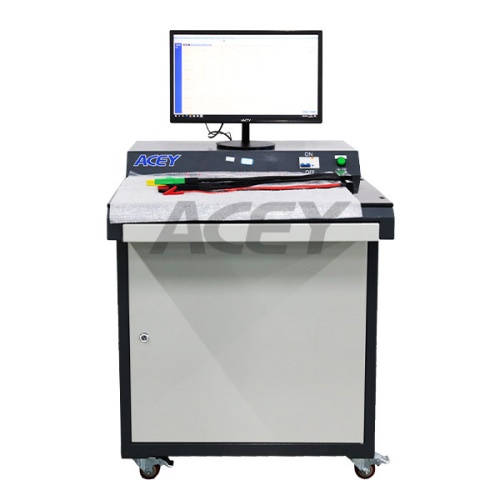
Step 7 — Finished Battery Pack Testing
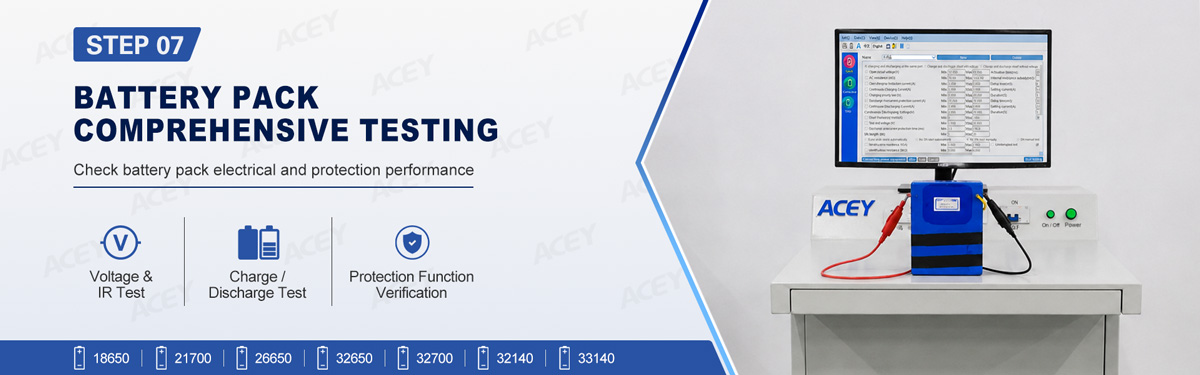
Once the BMS, wiring and electrical connections are complete, the battery pack is tested as a finished assembly.
This step checks components and connections introduced during battery pack assembly rather than the performance of an individual cell.
A battery comprehensive tester can be configured to test:
Upper and lower limits are set in the test program, allowing the equipment to identify qualified and unqualified packs.
Finished pack testing is particularly useful for detecting problems related to:
ACEY provides different voltage and current configurations for small and larger battery packs.
Recommended Equipment: Battery Comprehensive Tester
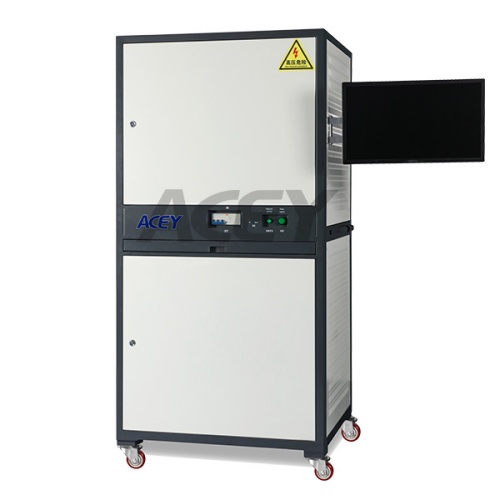
Step 8 — Battery Pack Packaging
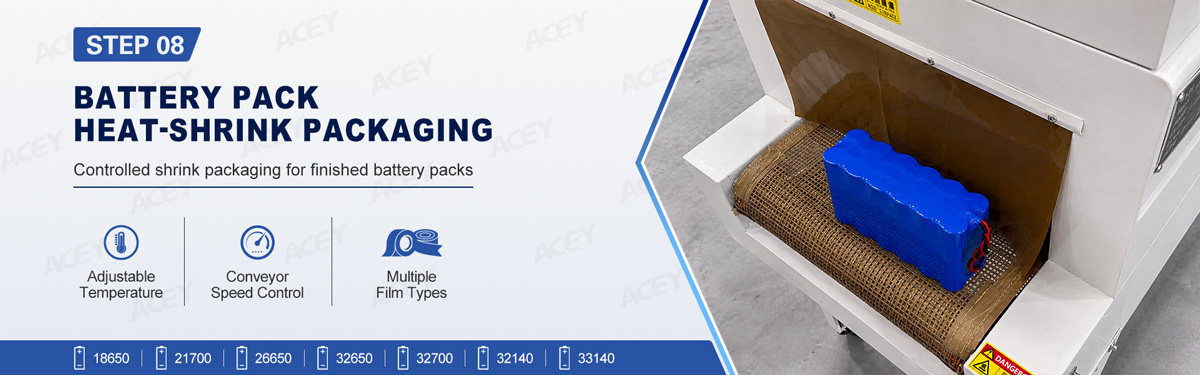
After electrical testing, the pack is prepared for final packaging.
The packaging method may include:
For heat-shrink packaging, the pack passes through a temperature-controlled shrink tunnel.
ACEY heat shrink machines are available with adjustable conveyor speed and temperature settings for different pack sizes and film materials.
Recommended Equipment: Automatic Heat Shrink Wrap Machine
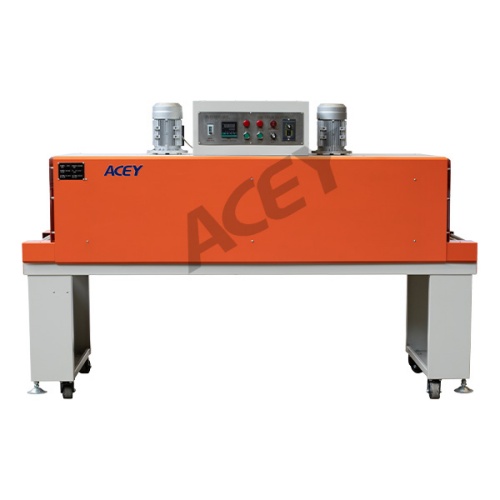
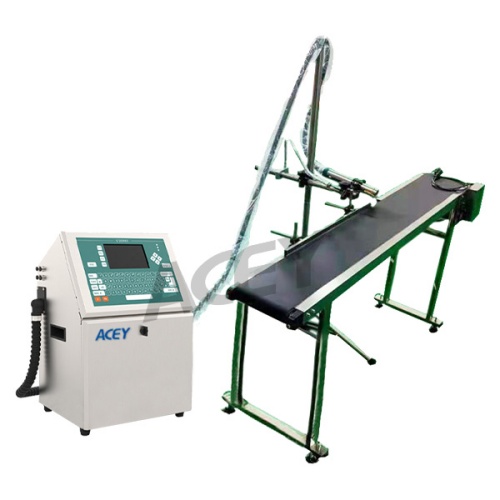
Step 9 — Coding and Traceability
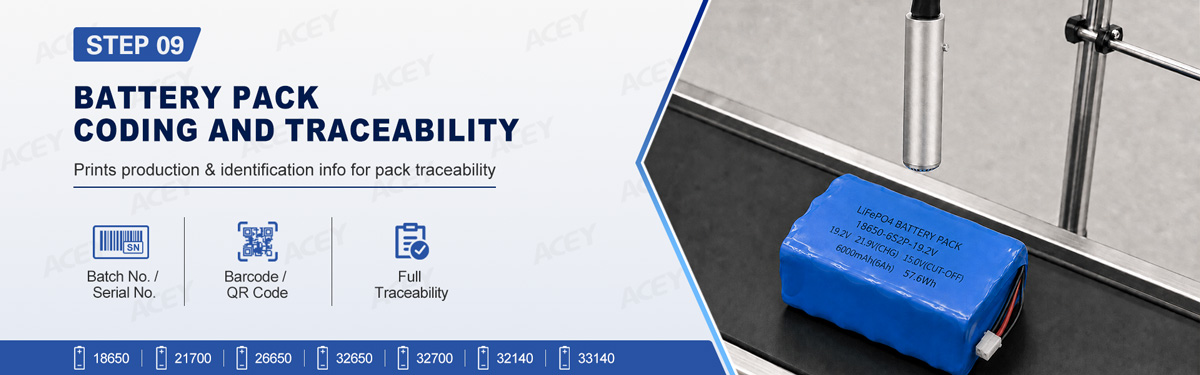
Pack identification is added before shipment or aging.
Printed information includes:
A handheld printer may be enough for small-batch production, while conveyor-based or continuous inkjet printers are more suitable for production lines.
If traceability is required, the printed code can be linked with earlier cell or pack test records.
Recommended Equipment: Battery Pack Coding Machine
Step 10 — Charge/Discharge Aging
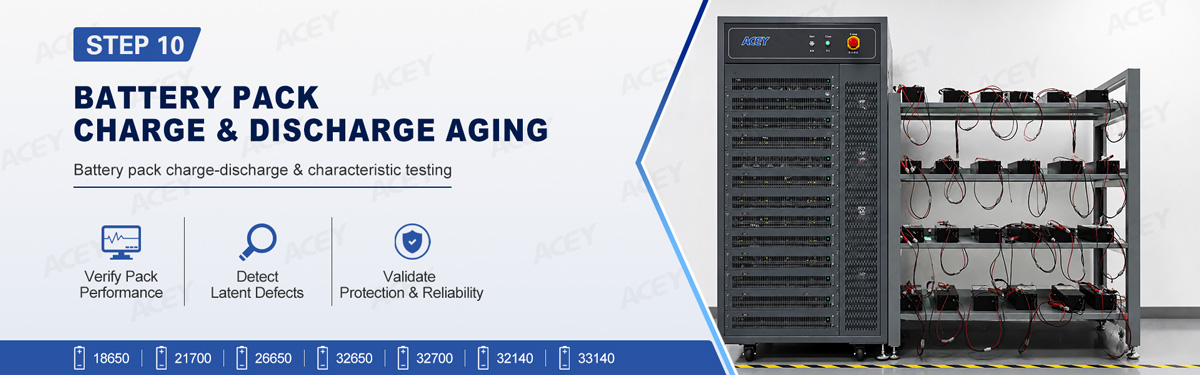
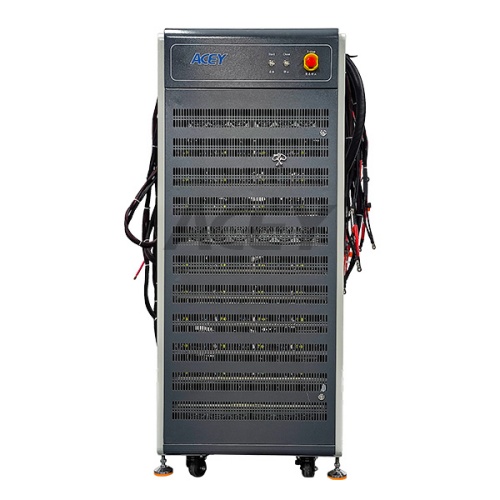
Aging is one of the final electrical verification steps.
The battery pack is charged and discharged according to a programmed test sequence. The system can record:
ACEY battery pack charge-discharge and aging systems cover a wide range of battery pack applications.
Available configurations include:
The selected tester must cover the pack’s maximum voltage and required charge/discharge current. Channel quantity is usually selected according to the planned production output and aging time.
For higher-power applications, energy-feedback systems can return part of the discharge energy to the electrical network instead of dissipating it only as heat.
Recommended Equipment: Battery Pack Aging Machine
Semi-Automatic or Fully Automatic?
The higher automation option is not always the better choice.
A semi-automatic production setup is more flexible when the manufacturer produces several battery pack models or changes fixtures frequently.
| Factor | Semi-Automatic Line | Fully Automatic Line |
| Production Volume | Small to medium | Medium to high |
| Investment | Lower | Higher |
| Changeover | More flexible | More dependent on tooling and line design |
| Labor | More manual operations | Lower labor requirement |
| Integration | Standalone or partially connected equipment | Integrated material flow |
| Traceability | Added where required | Easier to integrate across multiple processes |
Many cylindrical battery pack lines use a combination of both.
For example, cell sorting, CCD polarity inspection and automatic spot welding can be automated, while BMS installation, wiring or enclosure assembly remains manual.
This approach often gives better flexibility than trying to automate every process from the beginning.
How to Configure Cylindrical Battery Pack Assembly Equipment
The equipment should be selected from the actual battery pack design rather than only from the cell model.
Two 21700 battery packs may require completely different fixtures, welding machines and test systems if their series-parallel configuration, current requirement and mechanical structure are different.
Before equipment selection, it is useful to confirm the following information.
Cell Information
Battery Pack Design
Welding Information
BMS Information
Production Requirement
Testing Requirement
These details make it much easier to match each machine to the actual process and avoid buying equipment with either insufficient capacity or unnecessary specifications.
ACEY Cylindrical Battery Pack Assembly Solutions
ACEY supplies individual machines, semi-automatic production equipment and fully automatic assembly solutions for cylindrical lithium battery packs.
Equipment can be configured for cells including:
18650 · 21700 · 26650 · 32650 · 32700 · 32140 · 33140
Available processes cover:
For production-line projects, the configuration is developed around the customer’s battery pack, required output and test process rather than from a fixed machine list.
Planning a Cylindrical Battery Pack Project?
Please provide:
This information allows us to recommend the required machines, tooling, welding configuration and test system for the actual pack.
Discuss Your Battery Pack Assembly Project →
Frequently Asked Questions
*What machines are needed to make a cylindrical battery pack?
A typical production setup may include a cell grading machine, insulation paper sticking machine, OCV/IR sorter, CCD polarity tester, spot welder, BMS tester, battery comprehensive tester, packaging machine, coding machine and battery pack aging tester.
Small-batch production does not necessarily require all processes to be automated.
*What cylindrical cells can be used?
Common formats include 18650, 21700, 26650, 32650, 32700, 32140 and 33140.
Whether one machine can handle several cell sizes depends on its mechanical range and tooling. Fixtures, feeders and holders may need to be changed when switching cell formats.
What is the difference between capacity grading and OCV/IR sorting?
Capacity grading measures cell capacity through charge-discharge testing.
OCV/IR sorting measures open-circuit voltage and internal resistance and groups the cells according to preset ranges.
They are different steps and are often used together before battery pack assembly.
Why check cell polarity before welding?
A reversed cell can create the wrong series-parallel connection once the nickel strip is welded.
CCD inspection checks the complete cell arrangement before welding and identifies cells placed in the wrong direction.
What type of spot welder is used for cylindrical battery packs?
Resistance spot welding is commonly used for nickel and nickel-plated connecting strips.
ACEY provides 5000A, 8000A and 10000A welding power supply, including gantry, single-side automatic and double-side automatic configurations.
Параметры оборудования и сварки следует выбирать в соответствии с типом клеммы ячейки, материалом полосы, толщиной полосы и схемой сварки.
В чём разница между тестом и...Комплексное тестирование и испытания на старение комплекта Y?
Может ли одна производственная линия выпускать разные типы аккумуляторных батарей?
Да, но не без изменений.
При изменении диаметра ячеек, размеров блока или схемы сварки необходимо также изменить держатель, приспособление, подающее устройство или программу сварки.
Полуавтоматические линии обеспечивают большую гибкость для клиентов, производящих несколько моделей аккумуляторных батарей.
Какую информацию необходимо компании ACEY, прежде чем рекомендовать производственную линию?
Наиболее полезная информация:
Имея эти данные, оборудование и инструменты можно подбирать, исходя из особенностей конкретного аккумуляторного блока, а не используя типовую линейную конфигурацию.
Rm703, No.223, Qishan North Road, Huli District, Xiamen, Fujian, China
Эл. адрес : allen@xmacey.com
Тел. : +8618950009155
Whatsapp : +8618950009155